
Custom Shoe Storage Benches, Cupboards and Racks
A bespoke shoe storage bench combines a seat for putting on shoes with storage underneath, designed around your hallway, shoe collection and daily routine. The right layout balances easy access with the look you want, whether you prefer visible shelves or a tidier finish behind doors or drawers.
A bench that blocks the walkway, leaves no room for boots or clashes with the rest of your hallway can quickly become frustrating. A made-to-measure approach lets you plan these practical details before settling on a style.
In this guide, you’ll learn how to choose between benches, cupboards and open racks, tailor dimensions and materials, and plan for delivery, assembly and a comfortable hallway fit. We’ll also cover the details that help storage work for everyday shoes as well as bulkier pairs, so you can make a considered choice for your home.
Table of Contents
Custom dimensions and materials
A made-to-measure bench can be planned for an alcove, under-stair space or tight corner. Start by measuring the available space, then decide how you want the seat and storage to work.
Made-to-measure sizing
Custom sizing can adapt the bench’s width, height and depth to your hallway rather than dictate its layout. Measure the intended position, including skirting boards, nearby doors and the space needed to pass comfortably. An alcove, for example, might suit a narrower seat or storage that makes full use of its width.
Internal dimensions matter as much as the outside measurements. A shoe-partition depth of 23 cm gives a useful reference, but bulky footwear may need more room. Consider whether you’re storing everyday shoes, larger trainers or boots, then shape the compartments around that mix. A bespoke shoe storage bench can also combine open sections with drawers or cupboards.
Before settling on a layout, note which items need quick access and which can be tucked away. Deeper sections can accommodate boots and wellies, while lower drawers can keep shoes together. Keep the seat height and storage arrangement practical for the people who will use it.
Material selection
Wooden hallway storage offers a natural look, while the choice of timber and finish affects the piece’s appearance. Look at how the bench will sit alongside existing flooring, doors or furniture. A solid tabletop can also give the seat a substantial feel; one wooden shoe rack bench example has a 4 cm-thick solid top.
Finish is another decision. Some benches are offered with light or dark Danish Oil, described as water resistant. That finish can influence the colour and character of the wood, so consider which tone suits the hallway. For a boot room, ventilated sections and wipeable finishes can make practical sense alongside deeper storage.
Choose the material and layout together. Open shelves show the wood and keep footwear visible, while doors create a more concealed appearance. Pair the finish with the way the bench will be used, especially if it will store damp footwear or sit near an entrance.
Dimensions and hallway fit
A bench’s width, height and depth all affect how it works in a hallway. Compare its full footprint with the available floor space and the clearance needed for nearby doors.
Bench dimensions
Use a real product footprint as a starting point, not a universal template. One wooden shoe rack bench measures 60 cm high, 90 cm wide and 29 cm deep. Those figures show how height, width and depth combine in a single design. A made-to-measure bench can adapt its proportions to the space available.
Measure the intended position at floor level, noting any changes in wall width or floor shape. Check the depth against your seating and storage needs, and the width against the usable wall. A narrow section may suit a compact design, while a wider wall can accommodate more storage. Record all three measurements before deciding on the footprint.
Hallway fit
Typical UK hallways are around 90-120 cm wide, so depth can make a noticeable difference to the remaining passage. In a 90 cm hallway, a bench 29 cm deep would leave 61 cm between its front edge and the opposite wall, before accounting for other obstructions. Use the narrowest point, rather than the widest area, to judge the available clearance.
Map the route from the entrance to adjoining rooms. Allow space to open doors, drawers or cupboard fronts, and consider how people will pass someone sitting on the bench. In a compact hallway, shallow drawers, wall-mounted storage and slim cupboards can preserve floor space. Angled compartments, sliding doors or a bench with more than one use can also make a tight layout work harder.
A slimline Shaker boot-room bench is described as suitable for small hallways and new builds. Compare that profile with your measurements, especially where a wall narrows or the hallway turns. Marking the bench’s full width and depth on the floor can reveal pinch points before you choose its position.
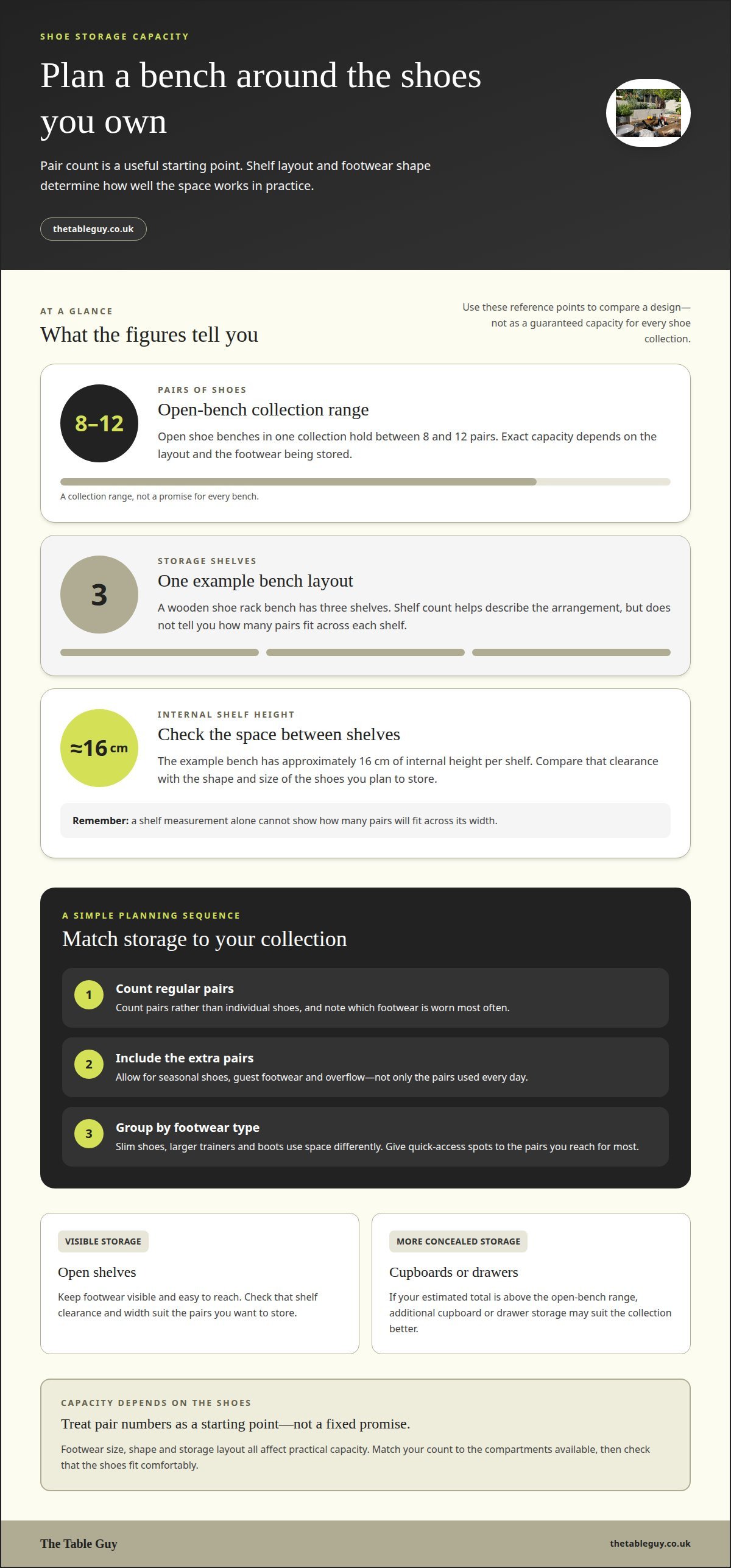
How many pairs of shoes fit in different bench designs?
Open shoe benches in one collection hold between 8 and 12 pairs. The exact capacity depends on the bench layout and the footwear being stored.
Start by counting the pairs regularly worn at home. Then consider seasonal shoes, guest footwear and overflow, so the plan accounts for more than today’s everyday pairs. Count pairs rather than individual shoes, and group them by type. This shows whether trainers, smarter shoes or bulkier footwear need the easiest access.
One wooden shoe rack bench has three storage shelves, each with approximately 16 cm of internal height. That gives a useful comparison when considering how shoes are arranged vertically. Check whether your everyday pairs can sit comfortably on each shelf, and whether the available space suits their shape. A shelf count alone doesn’t show how many pairs will fit across its width.
Footwear size and style affect practical capacity. Slim shoes may use shelf space differently from larger trainers, while boots need more room than low-cut pairs. Consider which shoes should be stored together, too. Separating household members’ shoes or everyday footwear from occasional pairs can make the bench easier to use without changing its overall capacity.
Use a simple planning sequence: count regular pairs, identify seasonal and guest shoes, then match those groups to the available shelves or compartments. Consider which pairs should stay visible and easy to reach. If the estimated total exceeds an open bench’s 8-to-12-pair range, a design with additional cupboard or drawer storage may suit the collection better.
For a made-to-measure layout, treat your shoe count as a starting point, not a promise of fixed capacity. Pair numbers are most useful when considered alongside footwear shape and size. This helps you choose storage for the collection you actually own, rather than relying on a shelf total alone.
How does a bespoke shoe bench compare with ready-made hallway benches?
A ready-made shoe cabinet has fixed dimensions. A made-to-measure design can instead fit an alcove, under-stair space or awkward corner, where standard proportions may not suit the available footprint.
That difference matters when a hallway has an unusual shape or a specific storage need. A fixed cabinet has a set width, depth and internal arrangement. A bespoke shoe storage bench can be planned around the space and the shoes it needs to hold, combining a seat and storage in one piece.
Compare each option using the same practical details. First, measure the position and note any sloping ceiling, doorway or nearby obstruction. Next, decide whether you want open shelves, drawers or cupboard doors. Then consider the footwear: everyday shoes, guest pairs and boots may need different spaces. These steps show whether a standard layout suits your routine or leaves space unused.
Ready-made furniture can be a sensible choice when its fixed dimensions and storage arrangement suit your hallway. There is no need to tailor the design around an unusual feature if the standard option fits. A custom piece is more relevant when standard measurements leave a gap, obstruct a route or make poor use of an under-stair space. The choice depends on how closely the available design matches your space and household needs.
Look beyond the outside shape. Check how doors and drawers open, whether shoes remain visible and whether the seat is comfortable to use. In a narrow entrance, a deep cabinet may take up too much floor space. In an alcove, a tailored width can make good use of the wall without leaving a standard cabinet sitting awkwardly.
Choose fixed dimensions when they suit your hallway and collection. Consider a made-to-measure design when a sloping ceiling, tight corner or under-stair space calls for a more considered layout.
The Table Guy
The Table Guy makes bespoke wooden furniture, including farmhouse tables and bamboo and hardwood tables. The same attention to materials, proportions and how a piece fits a room can guide your choices for other furniture, even if shoe storage is your immediate priority.
If you’re planning furniture for other parts of your home, consider how its dimensions and finish will work with your hallway scheme. The Table Guy also makes Prosecco dining tables and scaffold board and pine tables, each with a distinct character.
For a bespoke table project, contact The Table Guy to discuss your ideas.
Make your hallway feel considered
The entrance sets the tone for the rooms beyond it. Once you’ve chosen shoe storage that suits your household, consider how its materials, finish and character connect with the rest of your home. A bespoke shoe storage bench can be practical without feeling like an afterthought; thoughtful details can help create a welcoming, well-arranged space.
You don’t need to make every furnishing decision at once. Keep your hallway measurements and preferences in mind as you plan other pieces, so your home feels coherent without everything having to match. The Table Guy makes bespoke furniture for different interiors, with each design shaped around the project.
Ready to discuss an idea for your home? Contact The Table Guy and take the next step at your own pace.
Frequently Asked Questions
What is a bespoke shoe storage bench?
A bespoke shoe storage bench combines a seat with shoe storage designed for a particular hallway and household. Its layout can include open compartments, drawers or cupboard space, depending on how you want to organise footwear. For example, a family entrance might keep everyday shoes accessible while concealing less-used pairs. The defining feature is a design tailored to the space and its intended use.
What materials and finishes are available for custom shoe storage benches?
Wood is a common choice for a custom shoe bench, and the timber and finish shape its appearance and upkeep. Natural wood can show its grain, while a coloured or oiled finish changes the final look. Consider how the bench will sit beside the flooring and woodwork, and whether its surface will need regular wiping. The right choice balances your preferred appearance with how the hallway is used.
What dimensions should I choose for a hallway shoe storage bench?
Choose dimensions that fit the intended position without obstructing the route through your home. Measure the wall, then account for skirting boards, door swings and nearby radiators. Also consider how the bench will get into the hallway: a design that fits its final position may still be difficult to manoeuvre through a narrow entrance or around a stair turn. Check the route as well as the footprint.
How long does a UK-made bespoke shoe bench take to make and deliver?
Making and delivery are separate stages, and the timescale depends on the design, material choices, workshop schedule and delivery arrangements. A straightforward design and a more detailed custom layout may follow different production paths. Assembly also affects planning: a bench delivered ready to use has different arrival requirements from one that needs assembling at home. Allow for both manufacture and delivery when planning your hallway.
What safety and ventilation features should a shoe storage bench have?
For boot-room storage, ventilated sections can work alongside deeper compartments and wipeable finishes.
Which UK makers offer bespoke shoe storage benches?
The Table Guy creates made-to-order furniture. The wooden shoe rack bench is handmade in Somerset by a small team using natural wood described as sustainable.
Comments