
Extra long console tables: materials, dimensions and storage
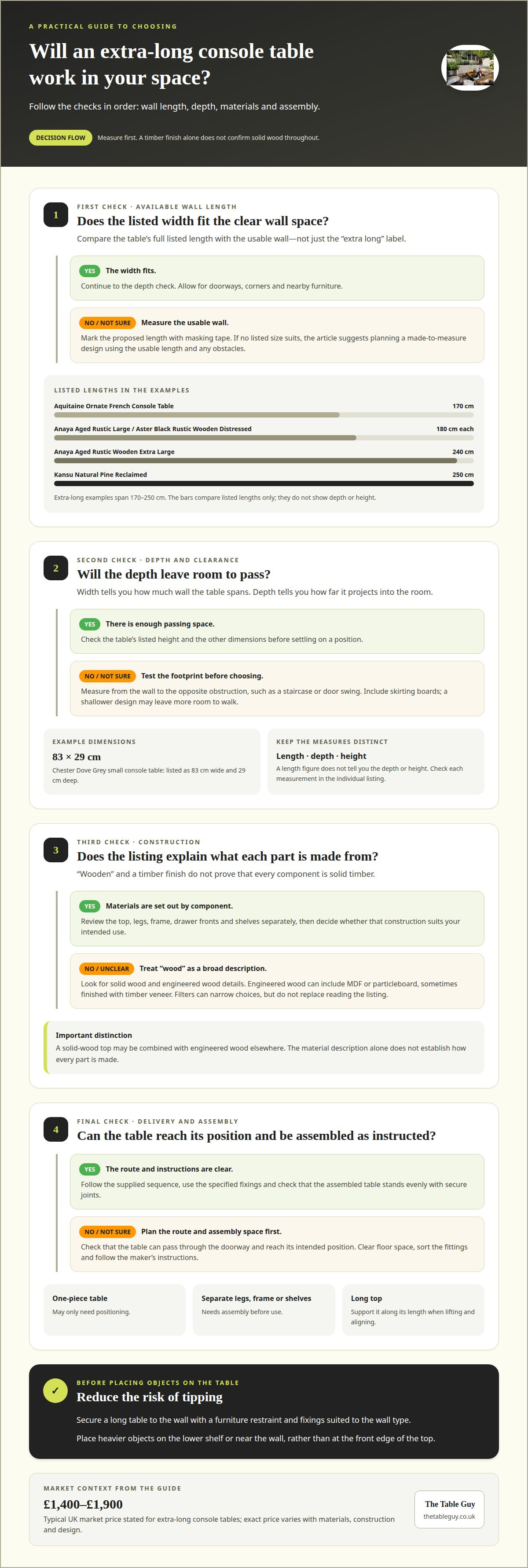
An extra long console table isn’t automatically solid wood throughout: its construction depends on the individual design, and a timber finish alone doesn’t tell you what every component is made from. Listed extra-long examples reach 250 cm, so both the materials and the space they’ll occupy deserve a close look before you choose.
It’s reasonable to want an extra long console table that feels sturdy and suits your home, without finding that its length crowds a hallway or its storage doesn’t work for everyday life. This guide explains how to assess solid and engineered wood, measure for a good fit, anticipate assembly and decide whether drawers or shelves will serve you better.
Length, depth, material and storage all affect the practical choice. Consider them together to picture the finished piece in your space and choose with confidence.
Table of Contents
Are the console tables solid wood throughout, or do they use engineered wood components?
The word “wooden” doesn’t mean every part is solid timber. Check the materials listed for the top, legs, frame, drawer fronts and shelves separately. A piece described as having a solid-wood top may use engineered wood elsewhere, so look for details about each component before deciding.
Engineered wood can include materials such as MDF or particleboard, sometimes finished with a timber veneer. That doesn’t automatically make a piece unsuitable. The important thing is to understand what you’re buying and whether its construction suits your intended use. If a listing only says “wood”, treat it as a broad description, not proof that the whole table is solid timber.
Filters help narrow the choice, but they don’t replace reading the material details. Select the depth and height that suit your room, then compare those measurements with the dimensions in the individual listing. For example, the Chester Dove Grey small console table is listed as 83 cm wide and 29 cm deep. Its measurements show how much wall and floor space it occupies, but don’t identify its construction.
Width and depth answer different questions. Width tells you how much wall the table spans; depth tells you how far it projects into a hallway or living space. Measure the intended position, including skirting boards and nearby doorways, then compare it with the listed depth. A shallower design may leave more room to walk, while a deeper top offers more surface area.
To reduce the risk of tipping, secure a long table to the wall with a furniture restraint and fixings suited to the wall type. Place heavier objects on the lower shelf or near the wall, rather than at the front edge of the top.
Use height filters to find tables that align with nearby furniture or suit how you’ll use the surface. Check the listed height and material details together: a good fit depends on the table’s proportions and construction, not just its finish.
What are the typical dimensions of the console tables, and will they fit against a standard hallway wall?
Extra-long console tables can span 170 cm to 250 cm, based on listed examples. The Anaya Aged Rustic Wooden Extra Large measures 240 cm, while the Kansu Natural Pine Reclaimed measures 250 cm. Those lengths suit a substantial stretch of wall, not every hallway.
There’s no standard hallway wall length that guarantees a fit. Measure the clear wall space and account for doorways, corners and nearby furniture. Compare the usable length with the table’s listed width, rather than relying on the “extra long” description.
Listed dimensions need careful reading. A table’s length, depth and height describe different aspects of its footprint and placement. The Anaya Aged Rustic Large and Aster Black Rustic Wooden Distressed are each listed as 180 cm long; the Aquitaine Ornate French Console Table measures 170 cm. These figures give a useful sense of length, but don’t tell you the depth or height. Check each measurement separately before deciding.
To test a possible position, mark the proposed length along the wall with masking tape. Then measure from the wall to the opposite obstruction, such as a staircase or door swing, to check whether the table’s depth leaves enough room to pass. Include skirting boards in your measurements, as they can affect how closely the table sits against the wall.
In the UK, extra-long console tables typically cost between £1,400 and £1,900 on the market. The exact price varies with the piece’s materials, construction and design.
You can buy an extra long console table from a UK furniture retailer or commission a made-to-measure piece. Before choosing, compare its listed dimensions and material details with your space.
Yes, a console table can be made to measure in the UK. Set the length, depth and height to suit the available wall space and how you plan to use the surface.
If no listed size suits your wall, sketch the usable length and note any obstacles before planning a made-to-measure design. Accurate measurements give the maker a clear starting point for tailoring the proportions to your hallway.
Assembly requirements
Assembly depends on the table’s construction and how it is delivered. A table supplied in one piece may only need positioning, while a design with separate legs, a frame or shelves needs assembly before use. Check the product instructions for the required tools and fixing sequence. Don’t assume every long table follows the same process.
Before starting, clear enough floor space for the top and frame. Unpack each component carefully, then match the legs, rails, shelves and fixings against the parts list. Keep screws and brackets together; mixing similar-looking fixings can make alignment difficult or damage a joint.
For a table with a separate frame, assemble the supporting structure first if the instructions specify that order. Keep each joint loose until the parts are aligned, then tighten the fixings evenly to prevent a leg or rail from sitting at an angle. Add a lower shelf only at the stage shown in the guide, as it may brace the frame.
Take particular care when lifting and aligning a long top. Support it along its length rather than balancing one end while attaching a leg. If the design uses brackets beneath the top, position them according to the marked holes or instructions. Don’t force a screw into a misaligned hole; reposition the parts first.
Check the space: make sure the assembled table can pass through the doorway and reach its intended position.
Follow the sequence: use the supplied instructions for the correct fittings and order.
Check the result: confirm the table stands evenly and its joints feel secure before placing objects on it.
Assembly can be awkward in a narrow hallway with little room to turn a long piece. Plan the route from the entrance to the final position before unpacking. A clear floor, sorted fittings and careful alignment make the work more manageable, but the maker’s instructions remain the guide for that table’s construction.
Drawers and lower shelves
Storage affects how a console table works day to day. Drawers conceal small items such as keys, post and charging leads, keeping the top clear for a lamp or display. A lower shelf keeps baskets, books or shoes visible and within reach. Choose according to what you need to store, not just the appearance of the front.
Drawer depth and access matter as much as the number of drawers. Think about what you’ll put away and whether it needs to lie flat or fit upright. Drawers suit keys and stationery; a shelf may be easier for a basket or larger pair of shoes. Check that drawers can open fully in their intended position, especially near a doorway.
Lower shelves use the space beneath the top, but their position affects what you can store there. A low shelf may suit shoes or baskets, while a higher shelf can keep books close at hand. Consider the space needed to slide items in and out, and whether the shelf will remain accessible beside nearby furniture.
Choose drawers for keys, letters and other small belongings you’d rather keep out of sight.
Choose a shelf for baskets, books or footwear that you want to reach quickly.
Combine storage types when you need concealed space and an open place for everyday items.
Before settling on a layout, list what the table needs to hold. A hallway, for example, might need a drawer for keys and post, with a shelf for a basket. In a living room, drawers could hold small accessories and the lower shelf books. This simple inventory helps you match the storage to its purpose.
If your ideal arrangement needs a particular balance of drawers and open space, plan storage around your space before choosing the finished design.
The Table Guy: Prosecco Dining Tables
If your furniture plans extend beyond the hallway to your dining space, The Table Guy makes bespoke dining tables to order. Choose from distinctive Prosecco Dining Tables, Farmhouse Tables, Bamboo & Hardwood Tables, and Scaffold Board & Pine Tables, each bringing different materials and character to a room.
Choosing furniture is about more than filling a space. The right timber, finish and proportions help create a home that feels considered and personal. If you’re planning a dining area alongside your hallway update, these made-to-order table styles offer a practical way to continue exploring handcrafted furniture.
Contact The Table Guy to discuss your furniture plans and the table style that suits your home.
Make the piece feel at home in your room
Before choosing an extra long console table, picture how you want the room to feel when you walk into it. It might create a considered focal point on a bare wall or connect the hallway with the character of the rest of your home. That intention can guide choices beyond dimensions, from the finish you like to how you’ll style the surface.
Keep the final look personal. A few meaningful objects can make a long surface feel welcoming, while leaving space around them lets the craftsmanship show. Consider the colours and textures already in the room, then choose a piece that complements them rather than competing for attention.
If you’d like a thoughtful steer as you decide what will suit your home, ask The Table Guy for help choosing. Take the next step at your own pace, and shape a room you’ll be glad to come home to.
Frequently Asked Questions
Do the console tables arrive fully assembled, or is some assembly required?
It depends on the individual table and its delivery format. A one-piece design may arrive ready to position, while a table with separate legs or supports may need assembly. Before delivery, consider how the largest component will pass through your entrance, stairwell and doorways. Keep the assembly instructions and fixings together, and follow the maker’s sequence for that design.
What wood types and finishes are the console tables available in?
Available woods and finishes vary by design. Console tables can be made from solid timber or engineered wood, sometimes with a veneer, and may have a painted, stained or natural-looking finish. These terms mean different things: stain changes the timber’s colour, while paint covers its surface. Read the details for the specific piece to understand its materials and appearance.
What counts as an extra-long console table in the UK?
There’s no single UK measurement that officially defines an extra long console table. The phrase describes a piece that spans more wall space than a compact hallway console. Judge the term against your room: a table may feel exceptionally long in a narrow entrance but well-proportioned beneath a broad living-room wall.
What are the standard lengths, depths and heights of console tables?
Console tables don’t have one standard set of dimensions; proportions vary by design and intended room. Length determines how much wall space is needed, depth affects how far the piece projects into the room, and height determines its relationship to nearby furniture. Compare all three measurements in the product details rather than choosing by length alone.
Which materials are best for a long console table?
The best material depends on the table’s design, the look you want and how you’ll use it. Solid timber shows its natural grain, while engineered wood can provide a consistent surface beneath a veneer or finish. For a long piece, consider the supporting frame and how the top joins it. Construction matters as much as material when assessing stability.
How do I choose the right console table length for my hallway or living room?
Start with the wall where the table will sit, then consider the room’s other features. For an extra long console table, allow for doors and walking routes in a hallway; in a living room, account for nearby seating, curtains and sockets. A piece that leaves these unobstructed is more likely to feel purposeful than one that simply fills the wall.



Comments