
Narrow Console Table for Hallway: How to Choose the Right Fit
Updated: Oct 21
What if the best hallway console is the one you barely notice as you walk past? In a narrow entrance, a little too much depth can turn a useful surface into an obstacle. Choosing a narrow console table for hallway use starts with protecting the everyday route through your home, not simply finding the slimmest-looking design.
It can be tricky to judge how much room you can spare while still making space for keys, post and the things you reach for on your way out. The right proportions should feel comfortable in daily use and welcoming when you come through the door.
This guide will help you measure your hallway, compare an open console with options that include storage, and choose a look that suits your home. You’ll also see how made-to-order dimensions can help address the practical limits of an individual space. The Table Guy makes bespoke furniture to order in its UK workshop, including consoles designed around the space and routine they need to serve.
Table of Contents
Why a narrow console table can make a hallway more useful
A console table is a relatively shallow piece of furniture designed to sit against a wall or behind larger furniture, offering a surface without the bulk of a wider table. The history and definition of console tables traces their development from wall-mounted furniture to the freestanding designs familiar today. In a hallway, a slim footprint can provide a useful landing place while leaving more room for people to pass through.
A narrow console table offers an everyday surface while helping preserve clear movement through the hall. The word “narrow” alone doesn’t tell you whether a particular piece will fit your passage comfortably.
What does a hallway console table do?
Think of it as a home for the few things you routinely carry in or out, such as keys, post, a wallet or sunglasses. Giving these essentials a dedicated surface can make arrivals and departures more organised, instead of letting them collect on a chair, windowsill or the nearest available ledge.
Keep the purpose practical first. A lamp, mirror or small decorative object can add warmth, but styling shouldn’t take over the space you need for the things you actually use.
When is a narrow design the better fit?
A slim profile is worth considering in a compact hall, along a tight route or where available wall space is limited. It can be more proportionate than a deeper piece, especially if people need to pass with coats, bags or shopping. But “narrow” doesn’t guarantee a comfortable fit. The right depth depends on the room, the position of doors and other obstacles, and how the hallway is used.
Consider the whole passage, not just the wall. A console may provide a handy surface yet leave too little room for a door to open freely or for people to pass one another. A slim table also won’t provide all the storage a busy household needs. Its role may simply be to hold a few essentials, with other belongings kept elsewhere.
Before deciding whether a narrow console table for hallway use is right for you, picture a typical moment at the entrance: someone putting down keys as another person passes, or a door swinging open beside the table. These everyday movements reveal more than appearance alone.
Notice where keys and post tend to gather now.
Consider whether a door, radiator or nearby furniture shares the same space.
Decide what needs to sit on the surface and what can be stored elsewhere.
A console earns its place when its modest footprint supports the way your household comes and goes. Start with that daily purpose, then judge whether the piece leaves the hall usable, not simply furnished.
Measure your hallway before choosing a narrow console table
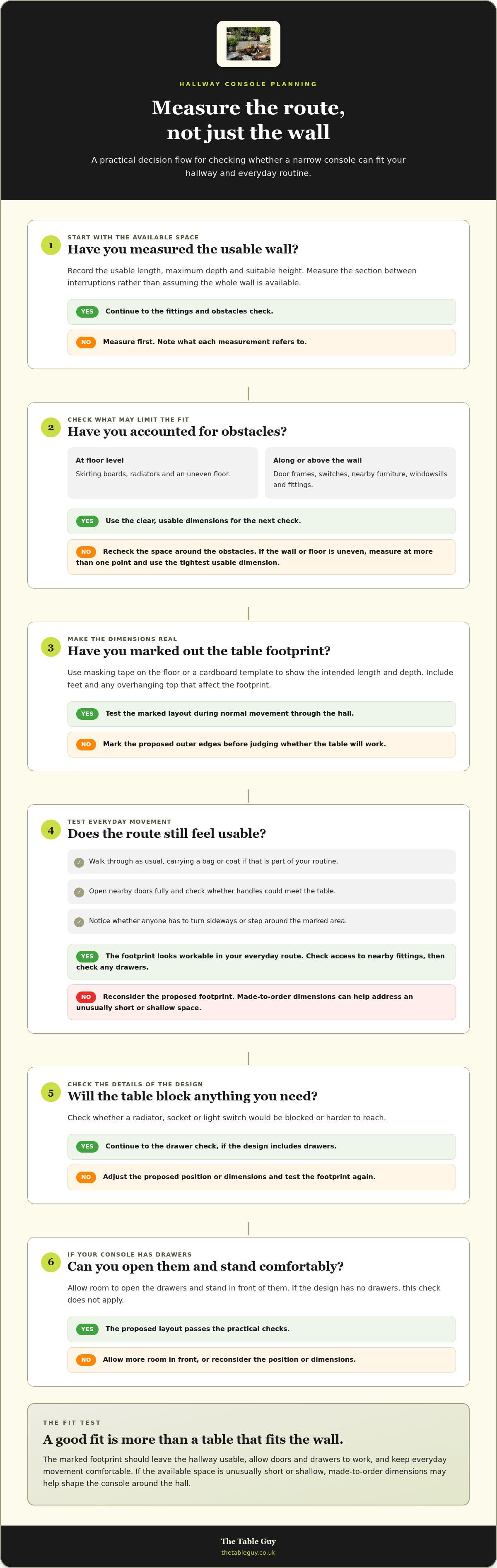
A few careful measurements can prevent a table from looking right on paper but feeling awkward in the hall. Start with the wall you have in mind, then measure the space the furniture and the people using it will need. For a narrow console table for hallway use, the key is not just its stated dimensions but how its footprint sits alongside doors, fittings and your normal walking route.
Which hallway dimensions should you record?
Work from the wall outwards. Record the usable length, maximum depth and suitable height. Measure the wall section between interruptions rather than assuming the whole length is available. Door frames, switches and nearby furniture can all limit where a console can sit.
Check details at floor level, too. Skirting boards may affect how close a table can sit to the wall, while radiators can reduce the useful length or depth. Look above the proposed surface for windowsills, wall details and fittings that could affect its height or your use of the space. If the wall or floor seems uneven, measure at more than one point and use the tightest usable dimension.
Keep a simple note of your measurements, including what each one refers to. This makes it easier to compare the available space with a table’s overall dimensions instead of relying on a quick visual estimate.
How can you test the layout before deciding?
Make the measurements real before choosing a piece. Use masking tape on the floor or cut a cardboard template to represent the intended length and depth. Mark where the table’s outer edges would sit, including any feet or overhanging top that affect its footprint.
Measurement tip: assess the remaining route with the table footprint marked in place. Walk through as you normally would, carrying a bag or coat if that’s part of your routine. Open nearby doors fully and notice whether anyone has to turn sideways or step around the marked area. A layout that looks clear when the hall is empty may feel different during a busy morning.
Check the door swing and whether handles could meet the table.
Stand where you’d usually reach the surface to put down keys or post.
If the design includes drawers, allow room to open them and stand comfortably in front.
Consider whether a radiator, socket or light switch would be blocked or harder to reach.
These checks help you judge more than whether a console physically fits. They show whether you can use it without creating a pinch point or making everyday movement feel cramped. If your measurements point to an unusually short or shallow space, made-to-order dimensions can help shape the piece around the hallway rather than forcing the room around standard proportions. The Table Guy makes bespoke consoles to order in its UK workshop. Explore bespoke hallway console furniture with your measurements in mind.
Open console or hallway storage: which narrow option suits you?
The choice isn’t simply between a bare table and a storage-heavy one. Think about what needs a home in the hall, how quickly you need to reach it and how much room you can spare to use the furniture. A narrow console table for hallway use can keep essentials close at hand, but adding drawers, shelves or a separate storage unit changes both capacity and the space around it.
More storage can help keep belongings together, but capacity takes space. A deeper cabinet, open drawer or second piece of furniture may encroach on a tight route, even if the furniture itself fits against the wall. Match the option to what you own and how you move through the hall, rather than assuming extra storage is always an advantage.
When is an open console table enough?
Choose an open design if you mainly want a light-looking surface and quick access to a few daily essentials. It may suit a household that keeps coats and shoes elsewhere and only needs somewhere for keys or post. Keep the top edited: a tray can gather small items while leaving room for practical use, rather than letting the surface become a drop zone for everything.
When should you consider a console with storage?
Drawers or shelves can give smaller belongings a defined place and help keep the tabletop clear. They’re useful if you regularly need to store items in the hallway, but check the space in front of and around the console. A drawer must open far enough to reach its contents, and a lower shelf should be accessible without making the passage awkward.
If the floor is already busy, consider whether storage could sit elsewhere. Wall shelving can move some belongings off the floor, though it still needs to suit the wall and what you plan to store. The Bespoke Shelving Units UK guide can help you think through that complementary option. In a very tight hall, keeping storage shallow or choosing one well-planned piece may be more practical than adding separate furniture.
Use your measured layout to compare each option’s real footprint, including the space needed to open or reach it. The best choice gives your belongings a sensible place without making everyday movement feel like a compromise.
Choose a hallway console table that works with your routine
A console is most useful when it answers a real need in your household. Before choosing its shape or storage, notice what happens at the entrance: what gets put down, what needs to be picked up on the way out, and where people pause to take off shoes or coats. Those habits will help you decide whether the tabletop should stay mostly clear, hold a few essentials or work alongside storage elsewhere.
What belongs on a hallway console?
Choose a small, useful group of everyday essentials, such as keys, post or something you regularly need before leaving. Keep departure items easy to spot and reach. Decorative objects can sit elsewhere on the surface or on the wall above. If everything ends up on the table, it becomes harder to find what you need and use the surface comfortably.
Placement matters as much as the objects themselves. Position the console where it’s convenient to reach on arrival, but not where it blocks a door, light switch or the natural walking route. Picture the entrance at its busiest, with someone coming in as another person heads out. The table should support that movement, not become something everyone has to sidestep.
How can a table complement the hallway’s look?
Let the materials and finish relate to details already in the home, such as the floor, doors or nearby furnishings. This doesn’t mean everything has to match. A considered contrast can feel at home too, provided the piece works with the room’s character rather than competing with it. A mirror or wall art above the table can add interest without using more floor space.
Keep the styling adaptable. A tray can gather small essentials, while a plant or rustic home accents from Lilyrose can add a personal touch. Leave enough of the top clear for its everyday job. In a compact hall, an arrangement that looks welcoming and is easy to use will serve you better than a crowded display.
Before settling on a narrow console table for hallway use, test its dimensions and intended role together. Mark the footprint you’ve measured, then try the routine you expect it to support. Use this quick checklist:
Can you reach the items you need without blocking the entrance?
Do doors, switches and the usual route remain clear?
Is there enough usable surface for daily essentials without crowding?
Does any planned storage suit your habits and fit the available space?
Do the material and finish sit comfortably with the hallway’s existing details?
If your routine calls for a particular balance of surface, storage and proportion, made-to-order furniture can respond to the space you have. The Table Guy makes bespoke consoles in its UK workshop. Explore bespoke console tables and consider a piece shaped around your hallway and the way you use it.
Make a narrow hallway console feel made for your home
A hallway rarely offers a perfectly clear rectangle for furniture. A door may sit close to the wall, a radiator can interrupt the available length, or the usual route through the house may leave only a particular depth to work with. Made-to-order dimensions let a console be planned around those real conditions, rather than choosing a size first and hoping it fits.
That’s the value of approaching a narrow console table for hallway use as part of the room’s layout. Your measurements, the items you want close to the entrance and the way your household moves through the space can all inform a more considered design.
What can be tailored in a bespoke console?
Length, depth and height each affect how a console fits and feels. The length needs to work with the usable section of wall; depth must respect the passage; and height influences how comfortably you can reach the surface. Your measurements give a starting point for considering these proportions in relation to the room.
Purpose matters too. If you mainly need somewhere to place keys and post, a clear, usable surface may be the priority. If certain belongings need a defined home, storage could be part of the design, provided there’s room to reach and use it. Materials also shape a piece’s character. The Table Guy works with materials including pine, hardwood, bamboo and scaffold boards across its furniture range, giving you options to consider alongside your hallway’s existing furnishings.
How to move from measurements to a considered design
Bring your notes together before settling on a direction. Include the usable wall length, available depth and suitable height, plus anything that interrupts the space, such as a door, skirting board, radiator or switch. Add a short list of what you want the console to hold and a few words about the look you’re drawn to, whether that’s a close match to existing furniture or a deliberate contrast.
This connects the practical details with the personal ones. A compact entrance with limited wall space may call for different proportions from a wider hall, while a household that uses the surface every day may have different priorities from one seeking a quieter, more decorative feature. Thinking through both helps keep the design useful as well as distinctive.
The Table Guy is a family-run UK furniture business established in 2014, making bespoke furniture to order in its UK workshop. Its consoles, sideboards and related furniture offer an alternative to choosing a piece by appearance alone. If you’re ready to explore a console shaped around your measurements and routine, Explore bespoke console furniture.
Give your hallway a thoughtful finishing touch
A well-chosen console can do more than fill an empty wall. It can become part of the small rituals that make coming home feel familiar, from setting down your keys to gathering what you need before heading out. Let the space guide your choice, and let your own taste give it character.
If a ready-made size doesn’t suit the wall or passage, a narrow console table for hallway use can be considered around the dimensions and routine that matter to you. The Table Guy’s range includes consoles, sideboards and shelving, so you can consider how a hallway piece might sit within the wider feel of your home.
Take your measurements and ideas with you as you explore what could work. Explore bespoke console furniture and start imagining a piece that feels naturally at home in your entrance. A few considered choices can make the space feel like yours.
Frequently Asked Questions
Can a narrow console table sit over a radiator?
It can, but only if the table doesn’t obstruct the radiator’s airflow or controls. Check the radiator manufacturer’s guidance for clearance, and consider whether heat could affect the table’s material, finish or anything you plan to keep on top. Don’t cover valves or controls. If the space traps heat or the radiator’s guidance rules out placing furniture above it, choose another position for the console.
How do you stop a narrow console table from wobbling?
First check whether the floor is uneven and whether the table’s joints or fixings have loosened. Place the table on a level part of the floor if possible, and use suitable furniture levelling feet or firm, purpose-made shims under a short leg. Avoid makeshift wedges that can slip. If the table still moves, don’t load it until you’ve identified and addressed the cause.
What should you display on a hallway console table?
Keep the surface useful: a small dish or tray for keys, a letter opener if you regularly sort post, and perhaps a compact lamp if the spot needs light. On a narrow console table for hallway use, leave room to set down a bag or parcel without knocking things over. Choose objects with stable bases, and move anything fragile away from the edge.
Can you secure a hallway console table to the wall?
Yes. A suitable anti-tip bracket can help restrain a console, particularly in a busy household. Use fixings intended for your wall construction, and follow the bracket and furniture instructions rather than choosing a screw by guesswork. Before drilling, check for concealed pipes and cables with an appropriate detector. If you’re unsure about the wall or fixing method, don’t drill until you can install the bracket safely.
How do you protect a wooden console table from scratches?
Use felt pads beneath decorative objects, and lift items rather than dragging them across the surface. A tray can protect the area where keys or other small belongings tend to land. Wipe away grit with a soft cloth before it gets rubbed into the finish, and deal promptly with spills. Cleaning products and care methods vary by finish, so follow the guidance for the particular piece.
Is a console table suitable for a hallway with children or pets?
It can be, provided the placement and contents suit the household. Secure the table against tipping where appropriate, and don’t encourage children to climb or pull themselves up on it. Keep breakable objects, trailing leads and small items that could be swallowed out of reach. For pets, consider whether tails, leads or excited movement could knock items from the edge, and keep the walking route unobstructed.
Can a hallway console table be used in another room later?
Yes, if its dimensions and purpose suit the new space. It might hold a lamp and books in a living room, provide a surface for serving dishes in a dining room, or support a carefully arranged dressing area in a bedroom. Before moving it, measure the new position and check how doors, seating or other furniture affect access. A change of room can give a well-chosen piece a fresh role.
Comments